BSB vs SWIFT code
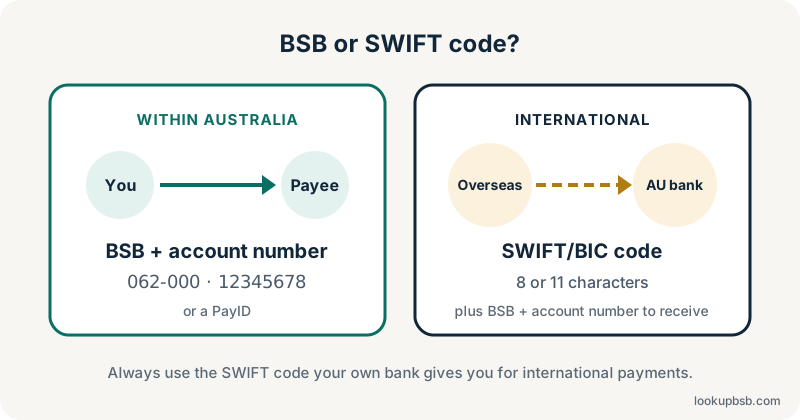
Use a BSB for payments within Australia. Use a SWIFT (BIC) code for international transfers. Receiving money from overseas usually needs both: your bank's SWIFT code plus your BSB and account number.
| BSB | SWIFT / BIC | |
|---|---|---|
| Used for | Domestic Australian payments | International transfers |
| Format | 6 digits, e.g. 062-000 | 8 or 11 letters and digits |
| Identifies | Institution and branch | Bank (and optionally a branch) worldwide |
| Issued by | Australian Payments Network | SWIFT |
How a SWIFT code is built
A SWIFT/BIC code has four parts: a four-letter bank code, a two-letter country code (AU for Australia), a two-character location code and, sometimes, a three-character branch code. Australian banks generally use one SWIFT code for incoming international payments, whatever your BSB.
Sending money overseas
To pay someone abroad you'll need their bank's SWIFT code and their account number or IBAN, not a BSB. Fees and exchange rates vary a lot between banks and money transfer services, so compare the total cost before sending.
Common questions
Do I need a BSB to receive money from overseas?
Usually you need your bank’s SWIFT/BIC code plus your BSB and account number. Many Australian banks ask overseas senders to put the BSB and account number together in the account field. Check your bank’s international payment instructions for the exact format.
Is a BSB the same as an IBAN?
No. Australia doesn’t use IBANs. Domestic payments use a BSB and account number; international payments add a SWIFT/BIC code.
Where do I find my bank’s SWIFT code?
On your bank’s website (search "international transfers" or "receive money from overseas") or in your banking app. Use the code your bank gives you, not one from a third-party list.
Reviewed 13 October 2026 by the LookupBSB team. General information only, not financial advice.